"Preventing sexual harassment is about creating a workplace where inappropriate behaviour is less likely to happen in the first place."
Training South West Training Team
Contrary to the focus of many employers on how to respond to issues of sexual harassment, it is not simply an HR issue that begins when somebody makes a complaint.
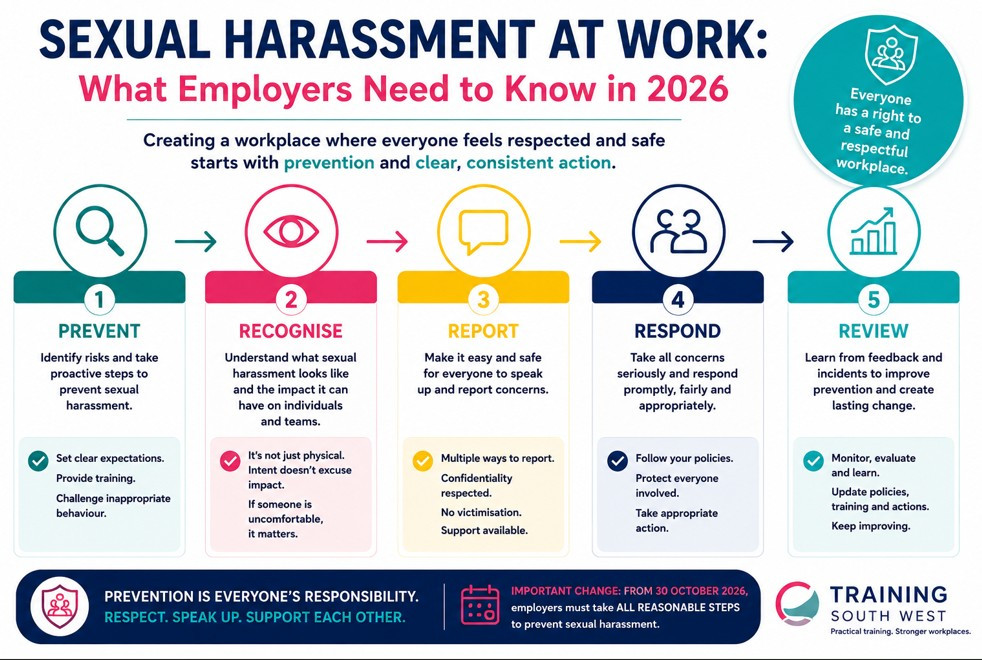
Since 26 October 2024, employers in Great Britain have had a positive legal duty to take reasonable steps to prevent sexual harassment of their workers. This is known as the preventative duty. Importantly, it is anticipatory: employers are expected to consider how sexual harassment could occur and take proactive steps rather than simply waiting for an incident. As such, prevention is a legal duty.
And the law is changing again.
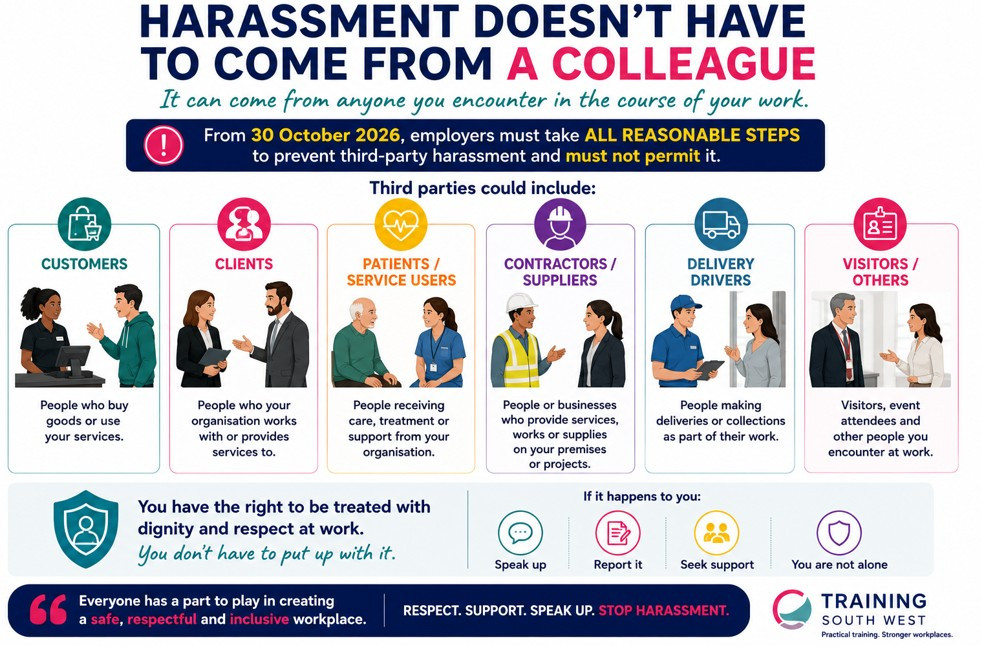
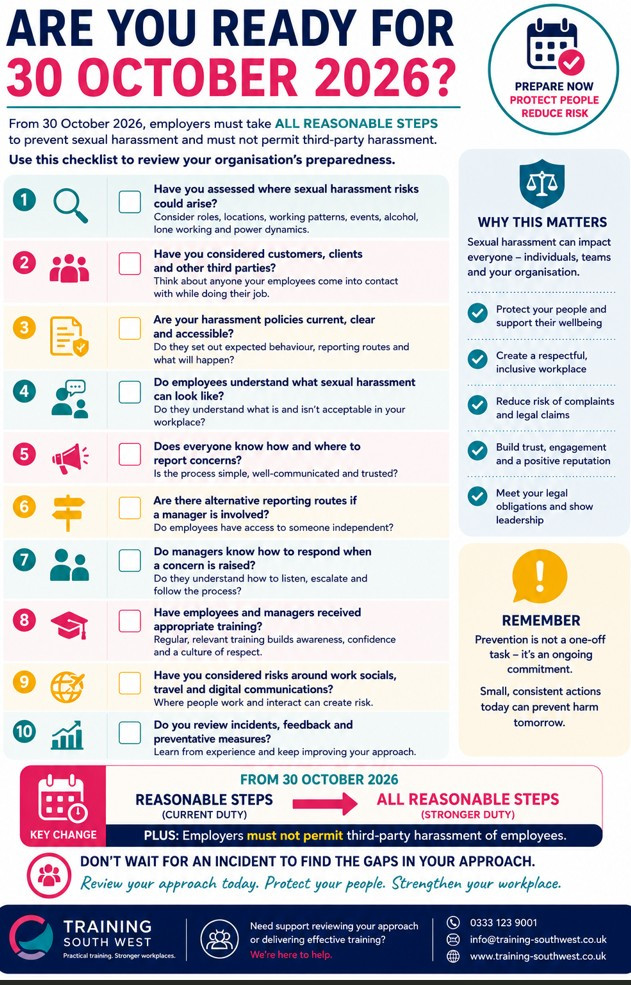
From 30 October 2026, employers will be required to take ALL reasonable steps to prevent sexual harassment. New provisions will also require employers not to permit harassment of employees by third parties, such as customers and clients.
For organisations, this creates a good reason to review existing arrangements now and to ensure complaince with the law:
- Do your employees understand what sexual harassment can look like?
- Have you considered where the risks exist in your workplace?
- Have you considered customers, clients, patients, suppliers and other third parties?
- Do people know how to report concerns?
- And, crucially, do managers know what to do when somebody raises one?
This guide explores the changing legal landscape and some of the practical steps employers can take to create safer, more respectful workplaces.
This guide provides general information rather than legal advice. Employers should refer to current EHRC, government and ACAS guidance and obtain legal advice where appropriate.
1. What Is Sexual Harassment at Work?
Let's start by looking at what we mean by 'Sexual Harassment'. Under the Equality Act 2010, sexual harassment involves unwanted conduct of a sexual nature that has the purpose or effect of violating someone's dignity or creating an intimidating, hostile, degrading, humiliating or offensive environment.
Sexual harassment does not have to involve physical contact. Depending on the circumstances, it might include sexual comments or jokes, intrusive sexual questions, displaying or sharing sexual material, unwanted touching, repeated unwanted advances, sexual gestures, suggestive messages or other unwanted conduct of a sexual nature.
It can also occur digitally. Messaging platforms, social media, email and other online communications do not somehow sit outside workplace expectations and EHRC guidance specifically recognises that it can occur in person and through channels such as social media, messaging tools and email.
Something we hear all too often is, "But it was only banter". Sexual Harassment laws are not in place to ruin anyone's fun, and workplace humour is not under threat. However, the difficulty arises when it becomes unwanted sexual conduct or contributes to an intimidating, degrading, humiliating, hostile or offensive environment. When someone says that their intent was to clear the air, or diffuse possible tension by joking, their intent does not mean their behaviour was acceptable.
An important consideration for managers and leaders is:
- When does joking become inappropriate?
- What happens if somebody initially joins in but later becomes uncomfortable?
- How should someone respond when a colleague says something inappropriate?
- What if the person behaving inappropriately is a customer rather than an employee?
These conversations should help managers translate legal requirements in to everyday behaviour and assess professional standards for their teams.
Since preventing sexual harassment also forms part of the wider challenge of creating an inclusive workplace culture, many organisations consider sexual harassment prevention alongside their wider equality, diversity and inclusion (DEI) training and workplace culture initiatives.
2. Employers' Sexual Harassment Legal Responsibilities
The preventative duty introduced in October 2024 represented an important shift away from response, with the requirement that employers should not simply wait until sexual harassment occurs before doing anything. EHRC guidance describes employers duty as anticipatory, requiring them to consider circumstances in which workers may experience sexual harassment and take proactive reasonable steps to prevent it.
What is reasonable will depend upon the employer and circumstances. It's also important to note that there is not currently a single universal checklist that automatically demonstrates compliance. It's possible that something may be available in the next year, but currently 'reasonable' must be determined by the employer. However, EHRC guidance points suggests risk assessment, effective policies, staff engagement, reporting mechanisms, training for workers and managers, appropriate responses to complaints, and ongoing monitoring and evaluation.
As such, an organisation cannot necessarily point to a policy written five years ago and assume the issue is covered. They need to show that that prevention is an active process and that they are regularly checking and updating their approach where necessary.
So, what could employers be considering now?
A practical approach might include:
- Assess the risks - Where could employees encounter sexual harassment? Which roles, locations, situations or working arrangements potentially increase exposure?
- Review policies and procedures - Are expectations clear? Do policies explain reporting routes and what happens when concerns are raised?
- Talk to employees - Do staff actually feel confident reporting concerns? Are there areas of risk that senior management may not see?
- Train employees - Do people understand sexual harassment, expected standards and how to raise concerns?
- Prepare managers - Do managers know how to respond appropriately when somebody tells them something has happened?
- Consider third parties - Could employees experience inappropriate behaviour from customers, clients, patients, contractors, suppliers or others?
- Review effectiveness - Are preventative measures working? Have new risks emerged?
EHRC guidance makes it clear that policies and procedures alone are not enough; prevention requires more active measures appropriate to the workplace.
3. What's Changing for Sexual Harassment in 30 October 2026?
The Employment Rights Act 2025 strengthens the existing preventative duty by requiring employers to take all reasonable steps rather than reasonable steps to prevent sexual harassment of employees, (effective from 30 October 2026). The legislation also provides powers for regulations to specify steps regarded as reasonable. These may include assessments, plans or policies, reporting arrangements and complaint-handling measures.
Government guidance states that further clear guidance will be published, so employers should be clear about the fact there there is currently no definitive new statutory checklist.
Importantly, employers should appreciate that 30 October is not the date to begin thinking about prevention as they already have a preventative duty. The forthcoming changes will serve to make the standard stronger.
4. Third-Party Harassment: What Employers Need to Understand
This is one of the most significant changes for employers. A third party is someone other than the employer or another employee. That could include a:
Customer • Client • Patient • Service user • Supplier • Contractor • Visitor
From 30 October 2026, an employer must not permit a third party to harass an employee. Under the legislation, an employer is treated as permitting this where the employee is harassed by the third party in the course of employment and the employer failed to take all reasonable steps to prevent it.
And this new provision includes harassment generally, not just sexual harassment. The explanatory notes state that it encompasses the three types of harassment under section 26 of the Equality Act (harassment related to protected characteristics, e.g. age, disability, gender reassignment, race, religion or belief, sex and sexual orientation, sexual harassment and less favourable treatment because an individual rejected conduct).
To explore 3rd party harassment, consider the following workplace scenarios.
- Hospitality - A customer repeatedly makes sexual comments about a member of staff despite being asked to stop.
- Healthcare or care - A patient makes persistent sexual remarks to an employee.
- Professional services - A client behaves sexually towards an employee during client entertainment or a business event.
- Retail - A customer repeatedly comments on an employee's body.
- Manufacturing or construction - A contractor working onsite regularly directs sexual jokes towards employees.
These examples illustrate why risk assessment matters.
Employers should consider not only relationships within the workforce, but also who their employees encounter while doing their jobs.
5. The Sexual Harassment Prevention Framework
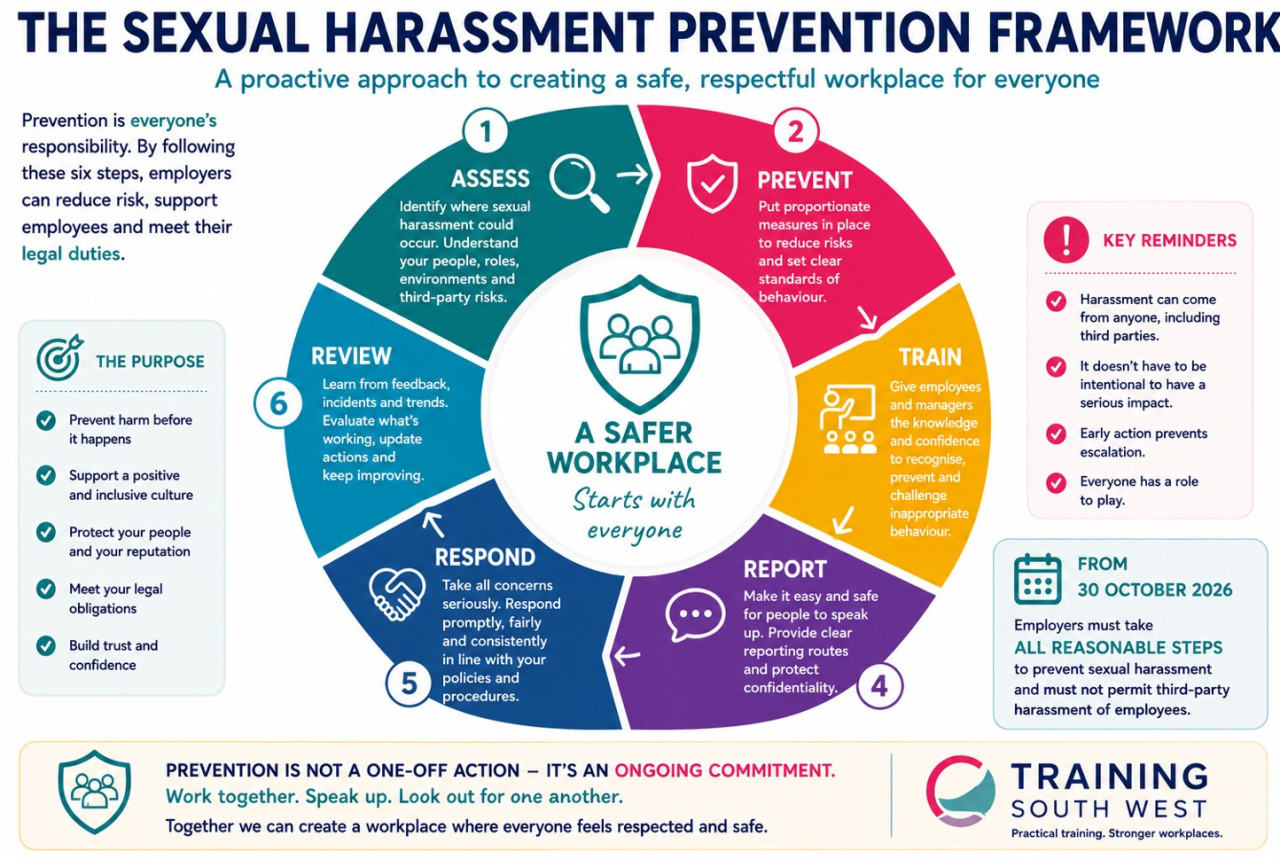
A useful way to approach prevention is through six stages:
- 1. ASSESS - Identify where sexual harassment could occur.
- Consider the nature of the work, working environment, power relationships, lone working, events, alcohol, travel, online communication and interaction with third parties.
- 2. PREVENT - Ask what proportionate steps could reduce those risks.
- That might include policies, clearer behavioural expectations, changes to working practices, customer protocols, reporting mechanisms or management intervention.
- 3. TRAIN - Ensure employees understand what sexual harassment can look like, expected standards of behaviour, how to report concerns and the role everyone plays in creating a respectful workplace.
- Managers may require additional training because they have responsibilities when concerns are raised.
- 4. REPORT - Employees need safe, accessible routes for raising concerns.
- Consider what happens if someone's concern involves their immediate manager. Is there another route?
- 5. RESPOND - Concerns should be taken seriously and handled fairly, sensitively and consistently in accordance with appropriate organisational procedure
s. - 6. REVIEW - Learn from complaints, employee feedback, incidents and changes to the workplace.
Prevention should evolve as risks evolve.
This Assess → Prevent → Train → Report → Respond → Review model closely reflects the proactive approach encouraged in existing EHRC guidance.
6. Why a Sexual Harassment Policy Isn't Enough
A good policy is important, but ask ten employees what the sexual harassment policy says and how many could tell you? It's fair to say, that a policy has limited preventative value if employees do not understand it, cannot find it or do not believe it will be followed.
It's essential that staff understand:
- what sexual harassment can look like;
- what standards of behaviour are expected;
- how to report something;
- what will happen if they do;
- where to go if their manager is involved;
- whether concerns will genuinely be taken seriously.
This is where sexual harassment training can play an important role as it can turn legal terminology and written policies into realistic workplace situations.
However, training shouldn't be treated as a compliance shield only. An employer cannot simply deliver an annual online module and assume every foreseeable risk has therefore been addressed. Instead, training works best as one component of a wider preventative approach incorporating leadership, risk assessment, policies, reporting arrangements, management capability and appropriate action.
EHRC guidance recommends training and regular evaluation alongside broader preventative measures.
7. Managers Have a Crucial Role in Preventing Harassment
Managers are often the first person an employee approaches and their response matters. Imagine an employee says:
"Can I tell you something? One of our clients keeps making comments to me, but I don't want to make a big thing of it."
A poorly prepared manager might say:
"I'm sure they don't mean anything by it."
Or,
"That's just what they're like."
Those responses can shut the conversation down immediately. As such, it's crucial that managers understand how to listen, avoid judgement, explain what they can and cannot keep confidential, follow organisational procedures and seek appropriate HR or specialist support.
These situations can be particularly challenging for managers, who may need to balance empathy, clarity and appropriate action while navigating a sensitive conversation. Developing managers' difficult conversation skills can help them approach challenging workplace discussions with greater confidence, while understanding when an issue needs to be escalated through the appropriate organisational process. Strong management training can help managers develop the communication, listening, feedback and people-management skills they need to create respectful teams, address inappropriate behaviour early and handle sensitive workplace situations with greater confidence.
A useful manager framework is:
- LISTEN - Give the person space to explain what has happened.
- TAKE IT SERIOUSLY - Avoid dismissing, minimising or immediately trying to explain the other person's behaviour.
- DON'T JUDGE OR BLAME - Avoid questions or comments that imply the person experiencing the behaviour caused it.
- BE CAREFUL ABOUT CONFIDENTIALITY - Don't make promises you may be unable to keep. Explain sensitively what may need to happen next.
- FOLLOW THE PROCESS - Managers should know the organisation's reporting and escalation procedures rather than improvising their own investigation.
- SEEK SUPPORT - Managers do not need to be employment lawyers or investigators. They do need to know when and where to obtain appropriate support. Manager-specific training is valuable because managers need more than awareness of what sexual harassment is. They need confidence responding when it appears in front of them.
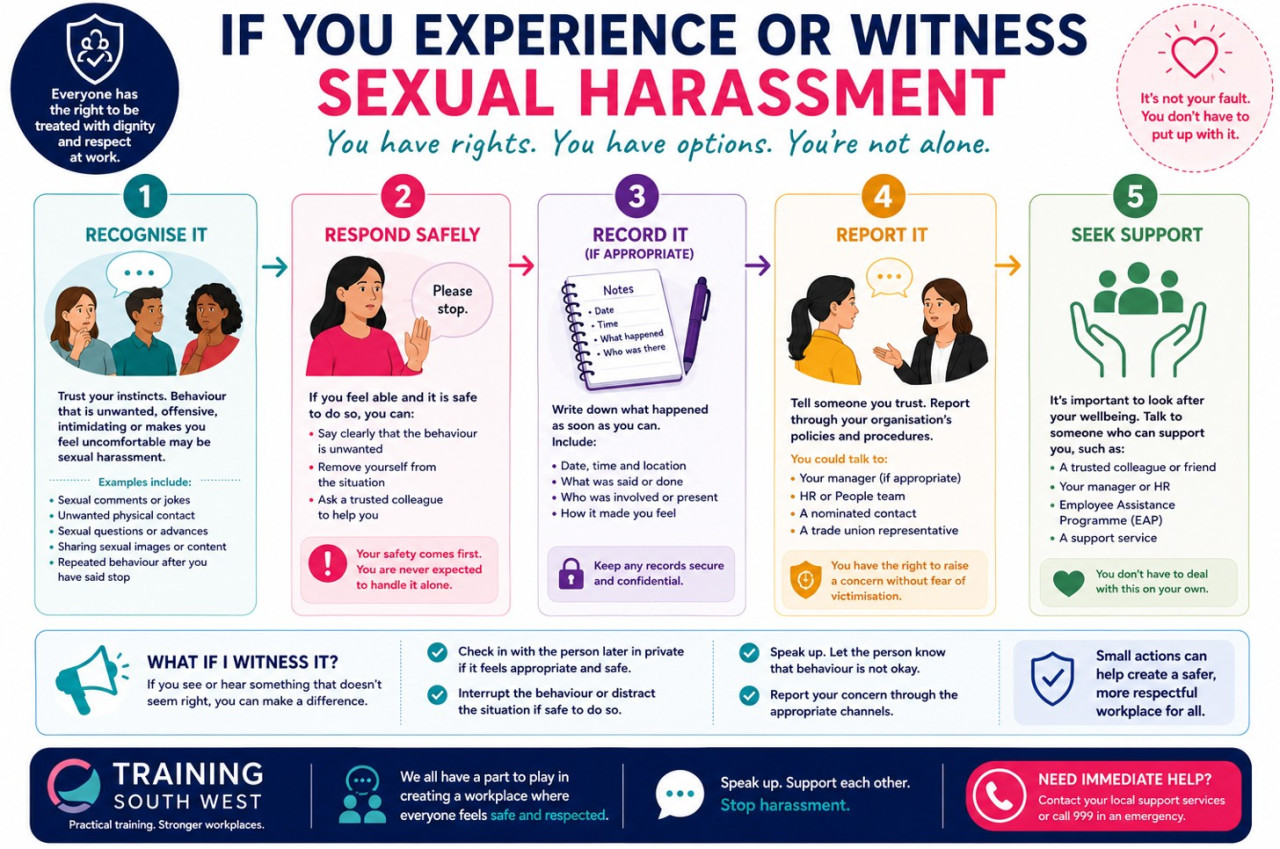
8. How Can Employees Help Prevent Sexual Harassment?
Preventing harassment is fundamentally an employer responsibility, but employees can contribute to a respectful workplace.
Employees should know:
- The standards of behaviour expected;
- What sexual harassment can look like;
- How concerns can be reported;
- Where to seek support;
- What to do if they witness inappropriate behaviour; and
- Hw to challenge inappropriate behaviour safely where they feel able to do so.
Bystanders can sometimes play an important role. Although it's important to stress, that does not mean employees should put themselves at risk or personally confront every situation. Depending on the circumstances, someone might challenge a comment, interrupt a situation, check in privately with a colleague, record what they witnessed or report a concern through an appropriate channel.
The key message should never be:
"Employees must stop harassment themselves."
It should be:
"You don't have to ignore inappropriate behaviour, and you should know where you can go for support."
9. Sexual Harassment Doesn't Stop at the Office Door
Employers should think broadly about where work takes place.
Potential situations include:
- Work socials and parties
- WhatsApp, Teams and other messaging platforms
- Social media
- Conferences
- Client entertainment
- Networking events
- Business travel
- Hotels
- Training events
- Online meetings
A Christmas party in a hotel is not somehow completely disconnected from work simply because people have left the office. Nor does a sexually inappropriate message become acceptable because it was sent through WhatsApp at 10pm rather than email at 10am.
Risk assessments should therefore reflect how employees actually work and interact, rather than focusing solely on behaviour at a desk between nine and five.
10. A Practical Sexual Harassment Prevention Checklist for Employers
With the October 2026 changes approaching, now is a sensible time to review your arrangements.
Ask:
☐ Have we assessed where sexual harassment risks could arise?
☐ Have we specifically considered third-party risks?
☐ Is our harassment/sexual harassment policy current and accessible?
☐ Do employees understand what sexual harassment can look like?
☐ Do employees understand expected standards of behaviour?
☐ Does everybody know how to report a concern?
☐ Are there alternative reporting routes if someone's manager is involved?
☐ Do managers know how to respond when someone raises a concern?
☐ Have managers received appropriate training?
☐ Have employees received appropriate awareness training?
☐ Have we considered work socials, travel and online communications?
☐ Do we consider risks involving customers, clients, patients, contractors and other third parties?
☐ Are concerns responded to consistently and appropriately?
☐ Do we review incidents and learn from them?
☐ Do we periodically review whether our preventative measures remain effective?
This isn't intended to be a definitive legal compliance test. The steps that are reasonable will depend upon the organisation and circumstances, and further government guidance on the 2026 changes is expected. It is, however, a useful starting point for asking:
Are we genuinely trying to prevent sexual harassment, or are we simply prepared to respond if somebody complains?
11. Creating a Culture Where People Speak Up
Policies and procedures only work when people feel able to use them and when they are fully communicated within an organisation. Employees may hesitate to report inappropriate behaviour for many reasons. They may worry they will not be believed. They may fear being labelled difficult. The person involved may be senior. The behaviour may involve an important client. They may be unsure whether what happened was "serious enough". Or they may simply want the behaviour to stop without triggering a formal process.
This means workplace culture matters enormously.
Leaders and managers need to communicate through their behaviour that concerns will be listened to and taken seriously.
If sexist or sexualised comments are routinely dismissed as banter, these behaviours may become normalised, boundaries might increase, and behaviour may escalatee. If senior people are excused because they "bring in a lot of business", then employees learn that sexual harassment is ok in the workplace. However, if their concerns are listened to and handled appropriately, that sends a very different message.
Prevention therefore isn't only about what the policy says. It's about what the organisation tolerates, challenges and reinforces every day.
12. Sexual Harassment Training in the South West
Organisations across Dorset, Somerset, Devon and Cornwall operate in very different environments, and their sexual harassment risks will not necessarily be the same. As such, our training programmes are fully customised to meet the specific needs of your working environments:
This is why effective sexual harassment training should connect with the workplace rather than simply reciting legislation.
Training for employees might explore recognising inappropriate behaviour, workplace standards, reporting, bystander awareness and third-party situations.
Training for managers should go further, helping them understand their role in prevention and practise responding appropriately when somebody raises a concern.
At Training South West, our approach is to make workplace training practical, relevant and engaging, using realistic situations to help participants understand not only what the law and organisational policy say, but what good practice looks like in everyday working life.
Final Takeaway
Key Consideration
Preventing sexual harassment requires more than a policy and more than a response when something goes wrong. Employers need to understand their risks, set clear expectations, equip managers and employees, provide trusted reporting routes, respond appropriately and keep their approach under review.
The legal landscape is strengthening, but the underlying objective is straightforward:
Create workplaces in which people are treated with dignity and respect — and take meaningful action to reduce the risk of harassment occurring.